When we follow the characters in a film, it is easy to take the landscape for granted. In this piece, I take the position that landscape “lies in excess of its narrative function as setting” (Lefebvre, 2006). In Ciro Guerra’s Embrace of the Serpent (2015), an Amazonian shaman travels with two scientists at different times to look for the sacred plant yakruna. The river makes both journeys possible. But what happens when the forest through which they travel looks so much like the Amazonia a viewer already expects to see?
When we speak of ‘landscape’, it is often assumed to be the same thing as nature. However, “it is not ‘land’, it is not ‘nature’, and it is not ‘space’” (Ingold, 2002: 190). One claim about the emergence of the Western idea of landscape concerns separation. Hirsch (1995: 6) suggests that “one concomitant of the process of ever-increasing intervention in nature was the simultaneous generation of new ideas of separation, such as that between subject and object.” In a cinema this separation can seem quite ordinary. I sit outside the forest and look at it. The person I see on screen, however, is making his way through it.
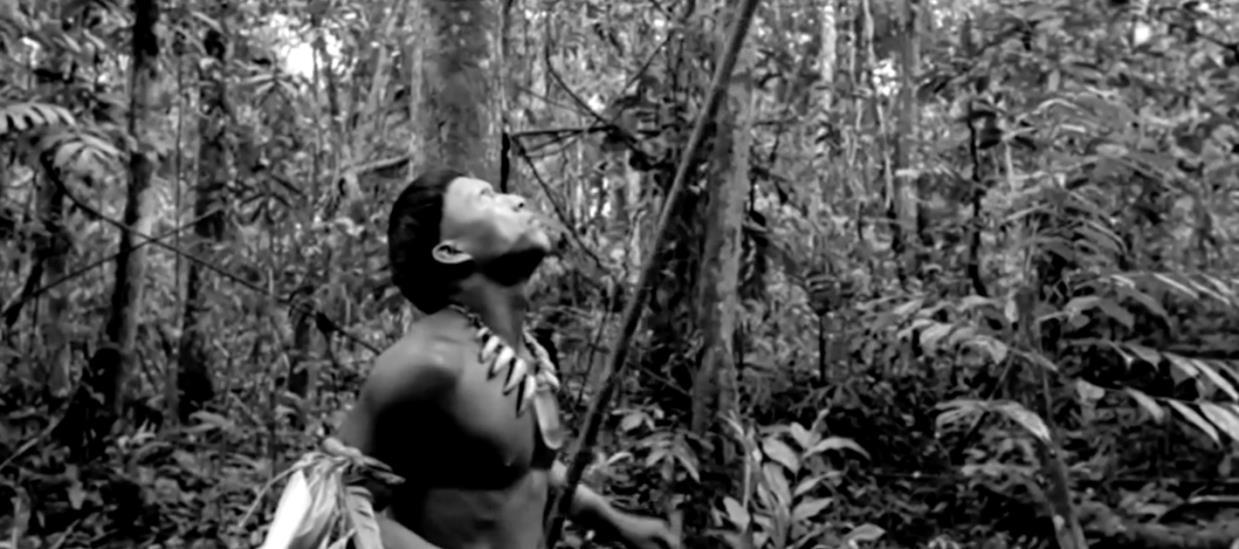
In a film, the director can choose a particular view to stand for a culture, and “with that frame, nature turns into the culture, land into landscape” (Lefebvre, 2006). As Hirsch (1995) observes, “people think each region has its own peculiar type of landscape.” In Embrace of the Serpent, Figure 1 shows a man in profile among the trees. If I describe the shot simply as a view of the jungle, the man becomes part of the scenery, although it is his figure that draws my eye. This is how a familiar image of Amazonia can reinforce what Gupta and Ferguson (1992) call “a natural association of a culture, a people, and a place”. This framing process is a cycle. When we construct such a landscape to fit our perception, it in turn frames our perception by repeatedly linking Indigenous people with the forest.
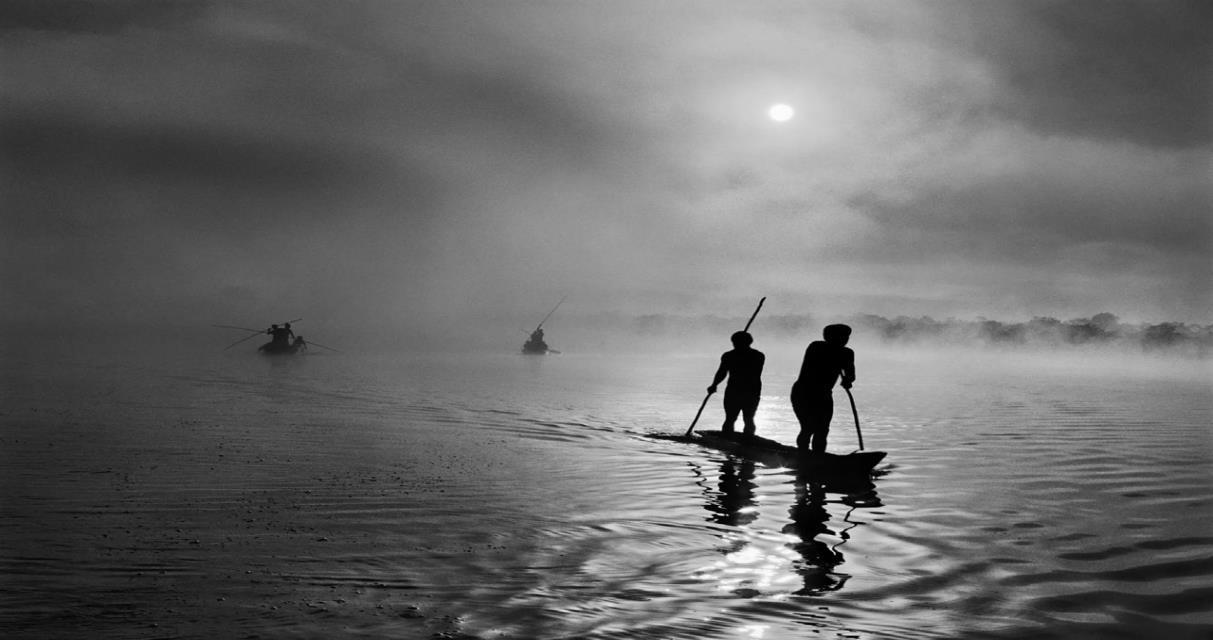
However, the bonds between people and lands are “in fact contested, uncertain, and in flux” (Gupta & Ferguson, 1992: 12). A good case in point is a photograph taken by Sebastião Salgado in 2005. Although not from a film, it helps explain how ‘primitivism’ is recreated through landscape. In Figure 2, fog hangs low over the water. The far shore is barely visible, while the two figures nearest the camera stand out against the light. Ball (2017: 29) describes a possible reading of this scene as “a languid and timeless morning into which an exemplar of early man sets out into an unknown world.” The fog obscures the shore. It tells us nothing about when the people in the photograph lived. It is the word ‘timeless’ that turns the difficulty of seeing across the water into a claim about the Wauja and their history.
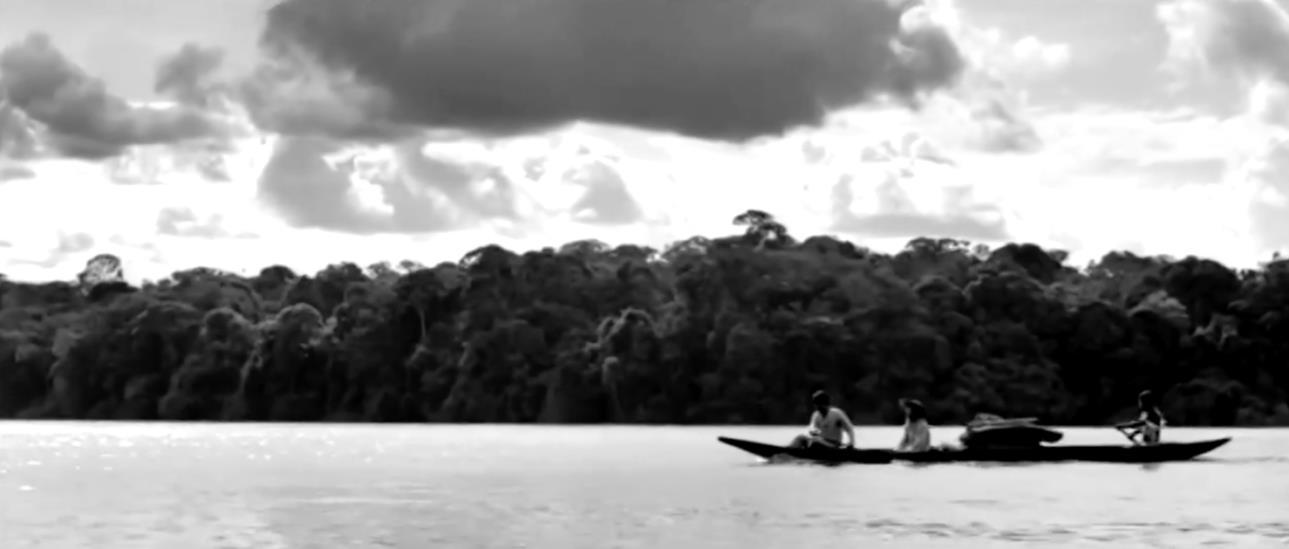
A stretch of water can also give a viewer a sense of time passing. Figure 3 shows the travellers canoeing along the river in Embrace of the Serpent. It is a landscape shown many times throughout the film. The same river carries the two expeditions decades apart. Seeing a canoe on it again, I recall the earlier journey and wonder what the next travellers will find. The uncertainty I associate with the flowing water comes from following those journeys, with their encounters with illness and the effects of Western intervention in Amazonia. Rich (2016) writes that the film “resists moral certainty”. The river offers no assurance that the second expedition will escape the harms of the first.
A comparison with RaMell Ross’s documentary Hale County This Morning, This Evening (2018) helped me see how much depends on the relation between shots. Ross moves from Daniel’s sweat at basketball practice to a storm. Rain becomes an echo of his physical effort because we have just watched him play.
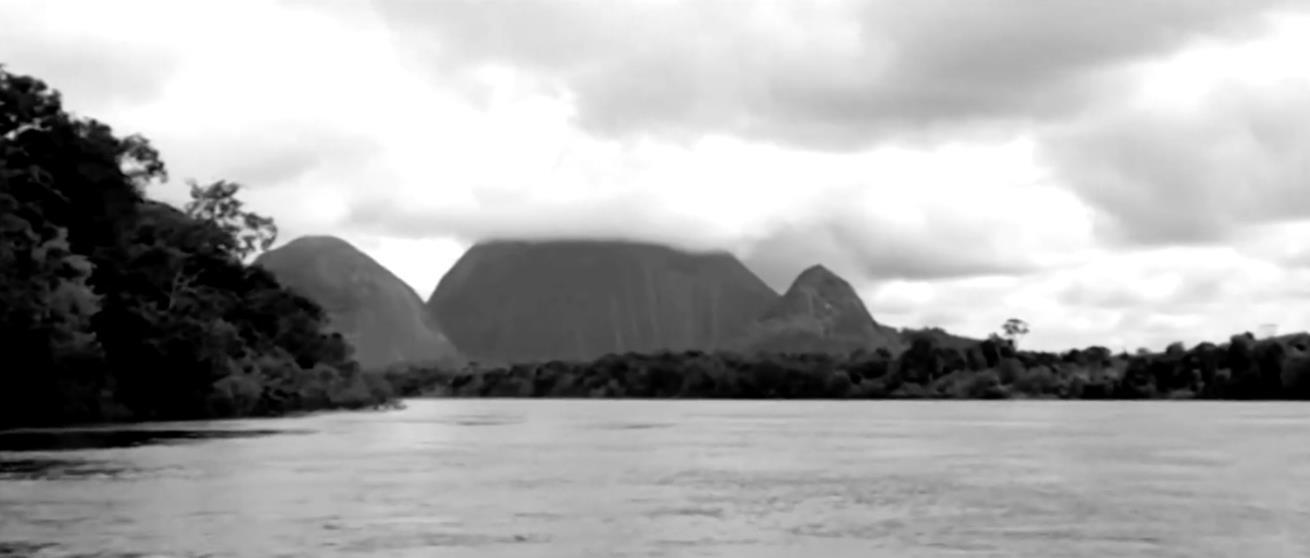
Guerra makes a different connection in Figure 4. A vast mountain suddenly comes into view behind low forests. It is on the top of the mountain that the travellers find the world’s last yakruna. From the water we can see the summit but not the plant. The height of the mountain makes the difficulty of reaching the last yakruna visible before we see the plant itself.
I take the stance that landscape is much more than just a setting in a film. Yet calling something a landscape can also limit what I see. In Figure 1, my own description of the forest risks making a man’s presence there seem self-explanatory. The river scenes ask more of the viewer. What has changed for those who travel this route between one journey and the next? This is why I suggest that it’s necessary to avoid the nature–culture dichotomy. If I set aside the river as ‘nature’ in order to study the people as ‘culture’, I lose the very route along which the film allows me to follow their history.
Bibliography
Ball, C. (2017). Let There Be Light: Wauja People and the Practice of Photographic Primitivism in Sebastião Salgado’s Genesis. Visual Anthropology Review, 33(1), 28–37. doi:10.1111/var.12119.
Guerra, C. (Director). (2015). Embrace of the Serpent [Film]. Ciudad Lunar Producciones.
Gupta, A. & Ferguson, J. (1992). Beyond “Culture”: Space, Identity, and the Politics of Difference. Cultural Anthropology, 7(1), 6–23. doi:10.1525/can.1992.7.1.02a00020.
Hirsch, E. & O’Hanlon, M. (eds.) (1995). The Anthropology of Landscape: Perspectives on Place and Space. Oxford: Oxford University Press.
Ingold, T. (2002). The Perception of the Environment: Essays on Livelihood, Dwelling and Skill. London: Routledge.
Lefebvre, M. (ed.) (2006). Landscape and Film. New York: Routledge.
Rich, N. (2016). An Amazon Without Certainty. The New York Review of Books.
Ross, R. (Director). (2018). Hale County This Morning, This Evening [Film]. The Cinema Guild.
Salgado, S. (2013). Genesis. Cologne: Taschen.